

Mighty natural wonders – the world’s largest waterfalls – and why the most spectacular one isn’t really a waterfall at all
A waterfall beneath the sea? Yes, it actually exists. And it’s the largest waterfall on Earth. Yet what looks from above as if the Indian Ocean is pouring into a dark abyss is, in reality, not a waterfall at all.
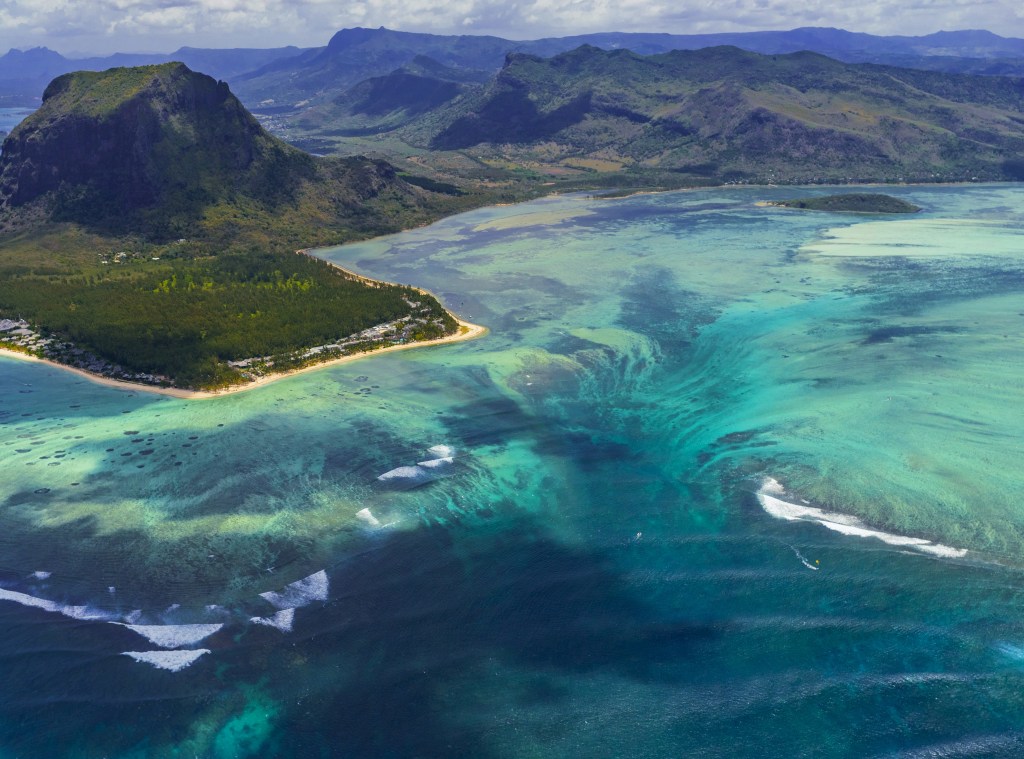
The Illusion off Mauritius
The gigantic turquoise “underwater waterfall” southwest of Mauritius is even visible from an airplane. Next to it rises the striking mountain Le Morne Brabant. From above, it seems as though the ocean is cascading over an edge into the depths.
In truth, however, it’s an optical illusion created by sand and sediments swept by ocean currents over the edge of the continental shelf. The current pulls light sand particles downward, where they spread into deeper parts of the ocean. And the interplay of light, depth, and color tricks our brains into perceiving a “falling” motion. A real, physical waterfall? No. But one of the most beautiful illusions nature has to offer.
The True Giants
So who are the real kings of waterfalls? The data speak for themselves, taking us deep into the planet’s geography, from Venezuela and Africa to a place no human can stand: beneath the sea.
As unbelievable as it sounds, the largest waterfall on Earth actually lies underwater. Between Greenland and Iceland, massive water masses rush through the Denmark Strait Cataract. Here, cold, dense water from the Arctic Ocean sinks beneath warmer water from the Atlantic, a temperature contrast that creates an invisible boundary.
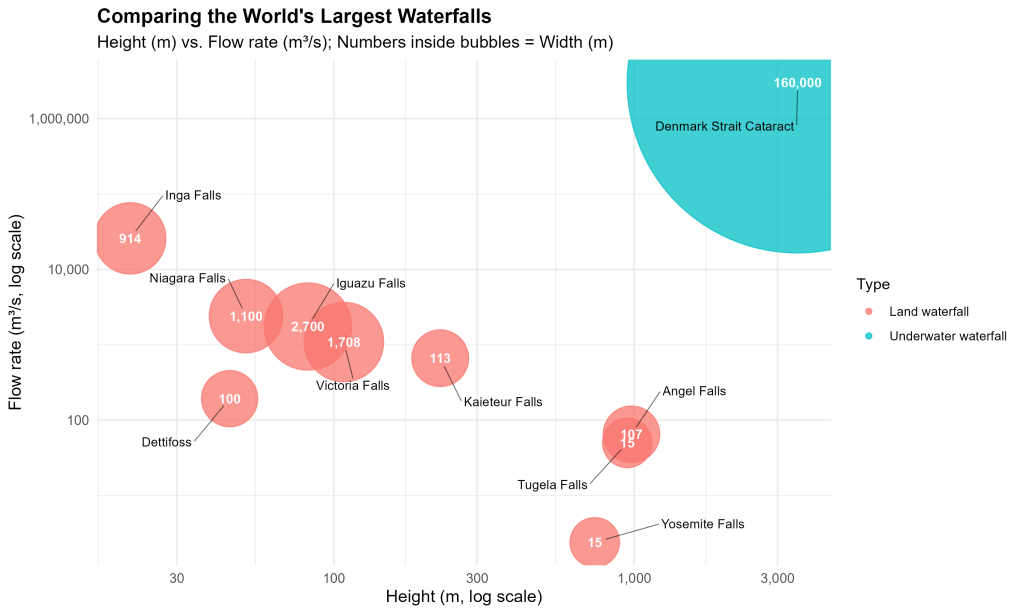
The cold water plunges 3,500 meters down — roughly three times higher than Mount Everest, measured from base to summit. Over 3 million cubic meters of water per second flow downward, that’s about the equivalent of 1,200 Niagara Falls at once.
Niagara Falls – Smaller, but Legendary
The Niagara Falls, on the other hand, are not record-holders in height or depth, but in symbolism. They stand for raw energy, romantic honeymoons, and the untamed power of nature across borders. Around 2,400 cubic meters of water per second thunder down between Canada and the United States, continuously. Their sight once moved French writer Gustave Flaubert to describe them as “a permanent natural catastrophe.”
Curious, I gathered data on the world’s most extreme waterfalls. The analysis shows: The highest is Angel Falls (Salto Ángel) in Venezuela, with an unbelievable 979-meter drop, but only a tiny water flow.
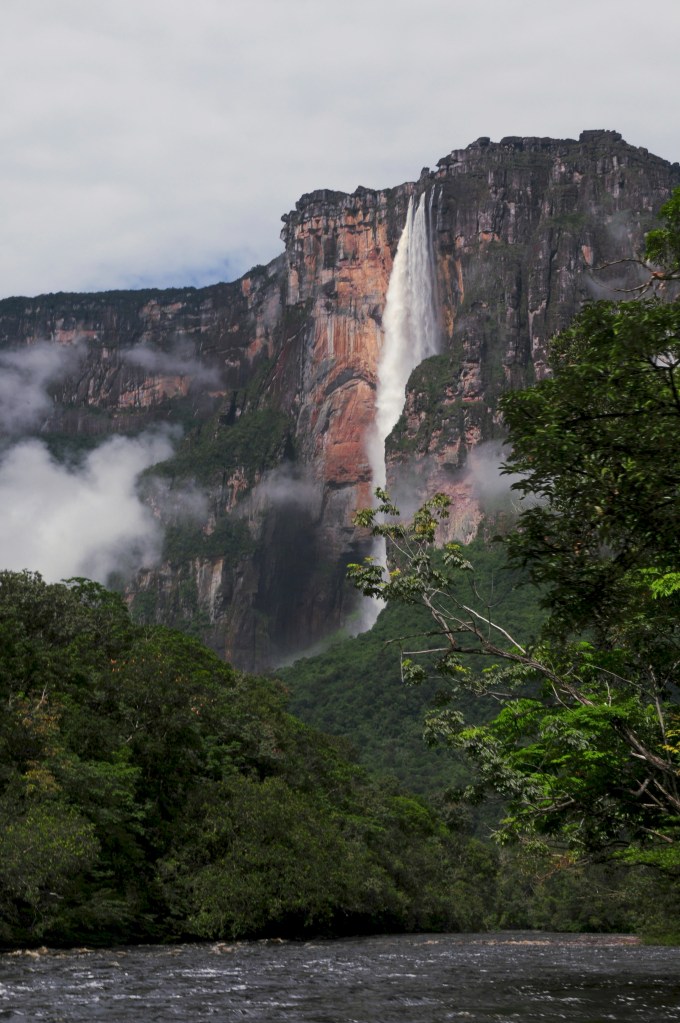
The most voluminous, Inga Falls in the Congo (25,768 m³/s), is barely higher than a four-story building. And the largest of all lies beneath the ocean, invisible, silent, yet physically immense.
The following diagram compares the dimensions of the world’s best-known waterfalls, height, width, and flow rate:
Earth is full of motion, even where we can’t see it. Whether it’s an invisible waterfall beneath the Denmark Strait or an illusion off Mauritius. What looks like magic is often just physics, beautiful enough to be art. – By Maike Martina Heinrich – Nov 2025
Cover Photo: Le Morne Mauritius from Helicopter – Photo: Christopher Brown, CC0, via Wikimedia Commons
Sources:
NOAA Ocean Service: Where is Earth’s Largest Waterfall? https://oceanservice.noaa.gov/facts/largest-waterfall.html
Britannica: Niagara Falls Victoria Falls https://www.britannica.com/summary/waterfall-geology
Wikipedia (List of Waterfalls by Flow Rate)
MauritiusNow.com: Underwater Waterfall Explained https://mauritiusnow.com/blog/things-to-do/underwater-waterfall-in-mauritius/
 Glimpse - The Data Lab
Leave a Reply