

What Determines Whether Sanctions Against a Regime Are Likely to Succeed (With Interactive Sanctions Explorer – Try If Your Sanctions Would Have Worked!)
When diplomacy fails, sanctions take center stage. Whether directed at Russia, Iran, or North Korea, economic pressure is widely regarded as the most powerful instrument available below the threshold of war. Politicians regularly speak of “severe consequences,” “unprecedented pressure,” or “crippling measures.” Yet history shows that while some sanctions force political concessions, others fail entirely. Some even strengthen the very regimes they are intended to weaken.
To investigate why sanctions sometimes work and sometimes do not, I analyzed 551 historical sanctions cases from the Global Sanctions Database. The GSDB tells us who sanctioned whom, what type of sanctions were imposed, and whether they were successful. What it does not tell us is whether the target country was democratic, corrupt, economically dependent, how much press freedom it had, or whether it was rich or poor. To fill these gaps, I combined the dataset with political indicators from the V-Dem Institute and economic indicators from the World Bank. The goal was to examine which structural conditions determine whether economic pressure translates into political results.
To do so, I trained a machine-learning model to distinguish between successful and unsuccessful sanctions. A Random Forest proved particularly suitable because it can identify complex patterns and interactions, such as situations where the success of sanctions depends not on a single factor but on the combination of democracy, trade, prosperity and sanction type.
The results are surprising
The success of sanctions depends less on what measures are imposed and far more on whom they are imposed against. The strongest predictors of sanction success were the economic and political characteristics of the target country. Particularly important were trade integration with the global economy, wealth (GDP per capita), the level of democracy, press freedom and corruption levels. By contrast, the specific type of sanction played a much smaller role.
In other words, whether sanctions work depends primarily on the structural characteristics of the target country.
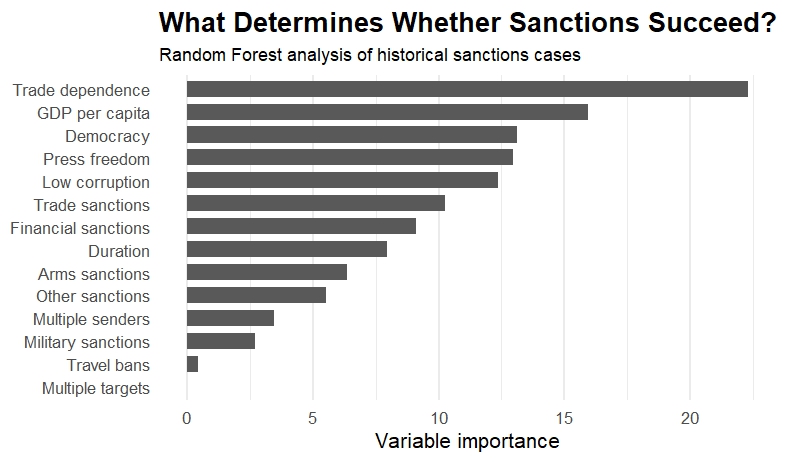
The Random Forest model achieved a prediction accuracy of 84 percent on independent test data. The results should not be interpreted as precise forecasts, but they provide robust evidence regarding the factors that have historically been associated with successful sanctions.
The Role of Global Trade
The strongest influencing factor was a country’s integration into international trade. Intuitively, one might expect that the more dependent a country is on global trade, the more effective sanctions should be. The data, however, tell a much more nuanced story.
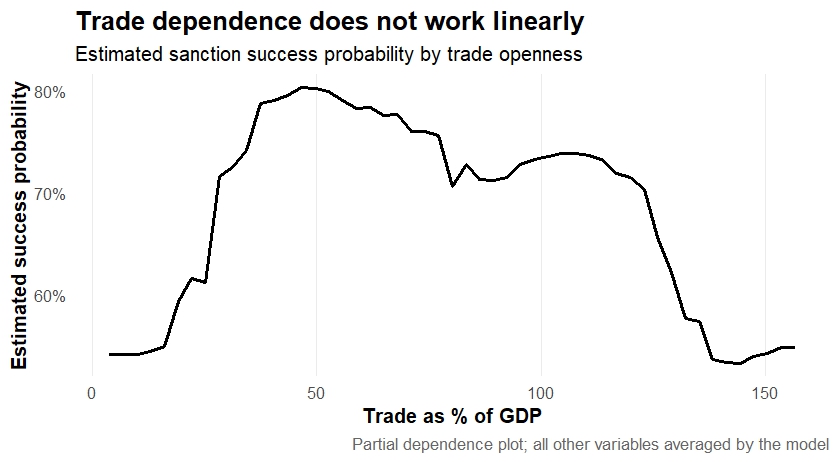
According to the model, sanction success was highest among countries with moderate levels of trade openness, roughly between 40 and 70 percent of GDP. In this range, the estimated probability of success exceeded 75 percent.
At very low levels of trade integration, sanctions were less likely to succeed. The same pattern appeared among highly globalized economies, where success probabilities declined again as trade openness increased beyond roughly 120 percent of GDP.
This suggests that the relationship between trade and sanction effectiveness is not linear. Countries with moderate trade exposure may be economically connected enough to feel external pressure, while still lacking the resilience and diversification of highly globalized economies.
By contrast, very open economies often possess extensive international networks, alternative trading partners, and stronger economic institutions that can help absorb external shocks. At the other extreme, highly isolated states may simply have fewer economic links that sanctions can disrupt in the first place.
Rather than “more trade equals more vulnerability,” the historical record suggests that sanction effectiveness depends on a more complex interaction between economic integration and a country’s ability to adapt to external pressure.
Democracy Matters Less Than Expected
Democracy was among the variables considered by the model, but its effect was much weaker than many observers might expect. Conventional wisdom suggests that democratic governments should be particularly sensitive to economic pressure because they must respond to voters, media scrutiny, and public opinion. The data, however, provide only limited support for this assumption.
While democracy contributed to the model’s predictions, economic factors such as trade openness and income levels proved substantially more important. The findings suggest that sanction success depends less on regime type alone and more on the broader economic and institutional environment in which a country operates. In short, democracy matters, but it is not the decisive factor many assume it to be.
Wealthier States Often Endure Longer
A country’s level of wealth also appeared to play a role. Among successful sanctions cases, the median GDP per capita was approximately $3,400. For unsuccessful sanctions, the median exceeded $4,200.
This pattern suggests that wealthier countries may be better equipped to absorb external economic pressure. Larger financial reserves, more diversified economies, and broader access to international markets can provide governments with additional options when facing sanctions.
The difference is not large enough to explain sanction outcomes on its own. However, together with trade openness and other structural factors, economic prosperity appears to contribute to a country’s overall resilience.
Which Sanctions Work Best?
In addition to the characteristics of target countries, I also examined which sanction types were most frequently associated with success.
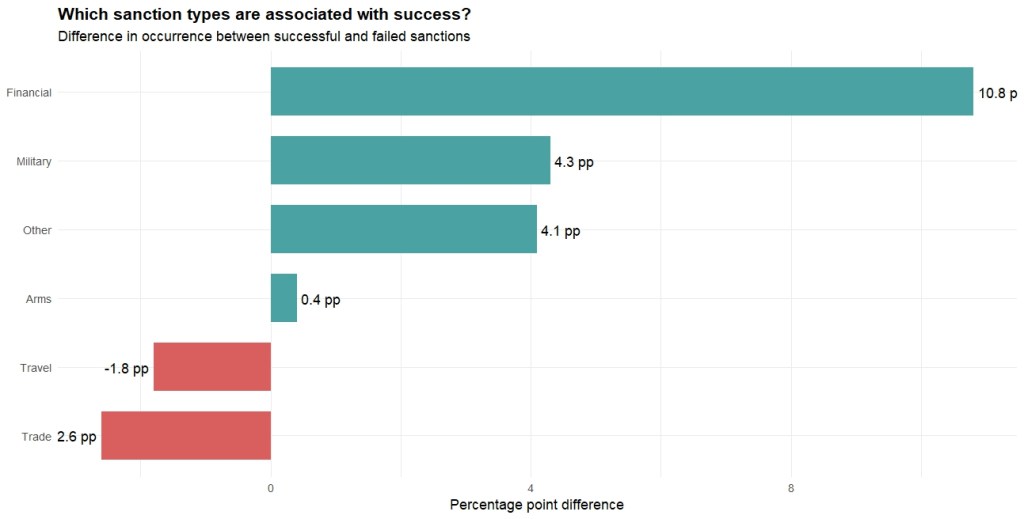
One category stands out in particular: financial sanctions. They appeared noticeably more often in successful cases than in unsuccessful ones. More than half of all successful sanctions cases included financial sanctions, while their share was considerably lower among failed cases.
By contrast, arms embargoes, travel restrictions, and military sanctions showed only minor differences. The statistical relationship falls just above the conventional significance threshold and should therefore be interpreted with caution. Nevertheless, the evidence suggests that restrictions targeting financial flows have historically been more effective than traditional trade sanctions.
The analysis demonstrates that sanctions are complex political instruments. Their success depends on numerous factors that cannot be fully measured. Domestic political dynamics, international alliances, geopolitical interests and the specific objectives of a sanction all play a role. Even a well-trained model cannot predict the future. What it can do, however, is help reveal patterns that are often overlooked in political debates.
To make these findings more accessible, I invite you to explore how different sanctions might have performed. To that end, I built an interactive Sanctions Explorer that allows you to simulate sanction scenarios yourself.
The machine-learning model running in the background is based on 551 historical sanctions cases and incorporates economic, political and institutional characteristics of the target country. The results are accompanied by AI-generated explanations that help interpret the model’s assessment. The estimated probability reflects similarity to historical cases in the training data and should be understood as an analytical aid rather than a prediction of future events.
Try it yourself and see whether your sanction decisions would have been associated with success.
Link to Interactive Sanctions Explorer:
https://hbblig-maike0h.shinyapps.io/sanctionsimulator
The findings of this analysis challenge a widely held assumption. The severity of a sanction is often less important than the characteristics of the target country. Trade integration, economic resilience, political structures and institutional conditions appear to influence the likelihood of success more strongly than the specific design of the sanctions themselves. Those who impose sanctions without considering these factors risk achieving little more than expensive symbolic politics. – by Maike Martina Heinrich – June 2026
Title Photo: William William on Unsplash
Code: https://github.com/Maike-H/Glimpse/blob/main/Sanctions
Sources: Global Sanctions Database (GSDB v4), Varieties of Democracy (V-Dem v16), and World Bank World Development Indicators (WDI).


Leave a Reply